
Pumbalkki 품밟기
The basic footwork traces a triangular pattern. Shifting weight between the feet keeps one leg free to step, kick or sweep while the other supports the body.
Learn how the traditional Korean martial art of Taekkyon connects rhythmic movement, controlled competition and respect for a partner.
Taekkyon (택견) is a Korean martial art built around a steady rhythm of steps and weight shifts. A practitioner can move from a soft, circular motion into a kick or sweep in the same rhythm. The arms move in concert with the feet, helping the practitioner keep balance, guard and redirect a partner's movement.
Control is part of the practice. Partners learn to read each other's timing, apply a technique with restraint and bow as a sign of respect.
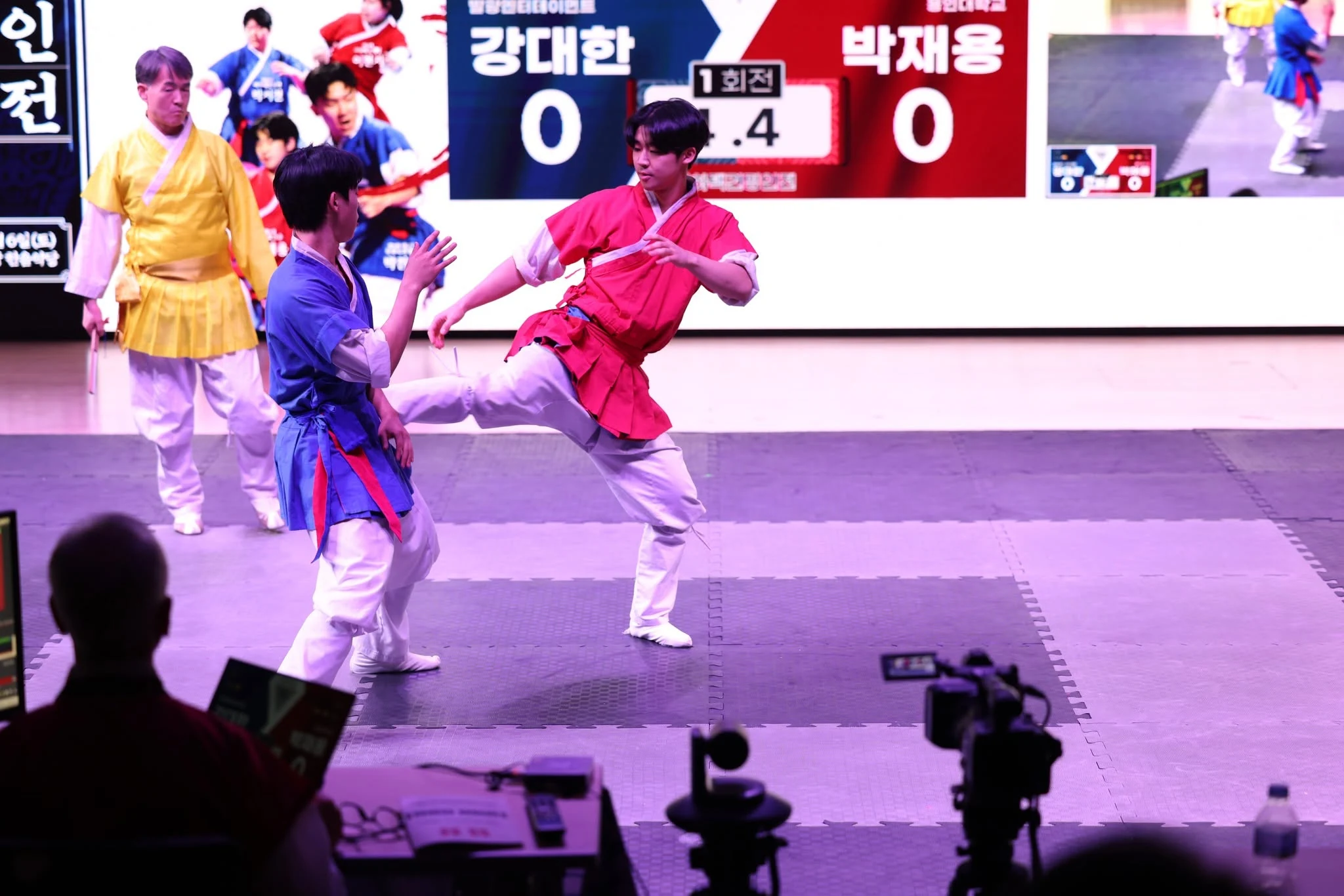
Taekkyon was practised as a folk contest in Seoul. The training books describe neighbourhood matches and the role of Song Dok-gi, who passed on skills he had learned in Seoul to later practitioners. As organised competition developed, Taekkyon also found new settings for teaching and practice.
The basic footwork traces a triangular pattern. Shifting weight between the feet keeps one leg free to step, kick or sweep while the other supports the body.
Coordinated arm movements follow the rhythm of the steps. In partner practice they also help the practitioner guard and adjust to a partner's approach.
Partner drills put footwork and upper-body movement together. Practitioners take turns applying and responding to techniques as they learn to judge distance, timing and balance.
Watch the feet as the competitors close the distance. A player may threaten a kick to draw a reaction, then sweep or hook the supporting leg as the opponent shifts weight. A player may also catch a kick and use the opening to unbalance the opponent.
Traditional match descriptions include bringing an opponent down or landing a permitted kick to the head. For specific scoring, fouls and referee signals, consult the rules materials for the event.